Maximilian Otto
Nest.js - TypeScript in the backend can also be clean
#1about 3 minutes
The architectural challenges of traditional Node.js backends
Standard Node.js with Express lacks a consistent architecture and built-in dependency injection, leading to inconsistencies across projects.
#2about 3 minutes
An introduction to the Nest.js framework
Nest.js is a popular TypeScript-first backend framework built on Node.js that provides a standardized architecture and uses Express under the hood.
#3about 2 minutes
Understanding the core features and modular architecture
Nest.js offers a powerful command-line interface, built-in validation, dependency injection, and a modular architecture based on controllers and services.
#4about 5 minutes
Scaffolding and exploring a new Nest.js application
Use the Nest CLI to generate a new project and explore the default structure, including the main entry point, controllers, services, and decorators.
#5about 2 minutes
Customizing REST API endpoints and parameters
Modify endpoint behavior by changing routes, setting custom HTTP status codes with `@HttpCode`, and capturing URL parameters using the `@Param` decorator.
#6about 2 minutes
Generating resources and CRUD endpoints with the CLI
Accelerate development by using the `nest g resource` command to scaffold a new module complete with a controller, service, and boilerplate CRUD endpoints.
#7about 4 minutes
Implementing automatic input validation with pipes
Use the built-in `ValidationPipe` and decorators from the `class-validator` package to automatically validate incoming request bodies and DTOs.
#8about 3 minutes
Managing dependencies between different modules
Enable communication between services in different modules by exporting providers from one module and importing that module into another.
#9about 1 minute
Deciding when to use Nest.js for your projects
Nest.js is highly recommended for complex, team-based backend projects using TypeScript, but may be overkill for simple prototypes or small applications.
Related jobs
Jobs that call for the skills explored in this talk.


Hubert Burda Media
München, Germany
€80-95K
Intermediate
Senior
JavaScript
Node.js
+1

tree-IT GmbH
Bad Neustadt an der Saale, Germany
€54-80K
Intermediate
Senior
Java
TypeScript
+1
Matching moments
03:22 MIN
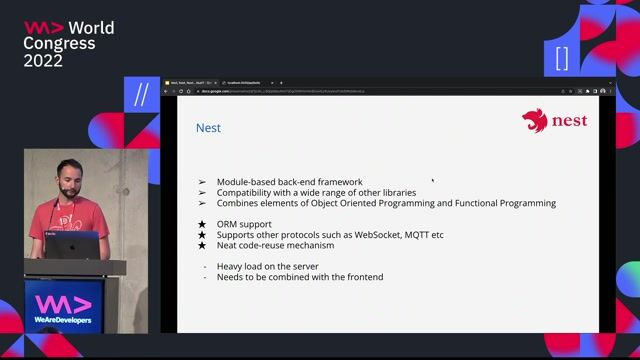
Building a full-stack backend with NestJS
Next, Nest, Nuxt… Nust?

06:38 MIN
Comparing Fastify with NestJS and Express
1, 2, 3... Fastify!
03:58 MIN
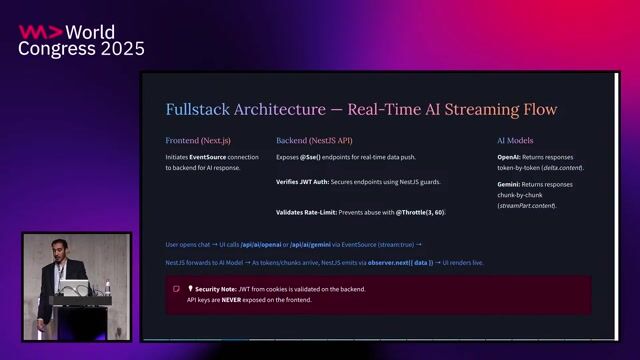
A full-stack architecture for streaming AI responses
Streaming AI Responses in Real-Time with SSE in Next.js & NestJS

04:25 MIN
Rethinking frameworks with Nuxt, Nitro, and UnJS
Building for the Edge - Crafting a Next-Gen Framework

01:26 MIN
Q&A on Deno's maturity and framework preference
Next, Nest, Nuxt… Nust?
02:37 MIN
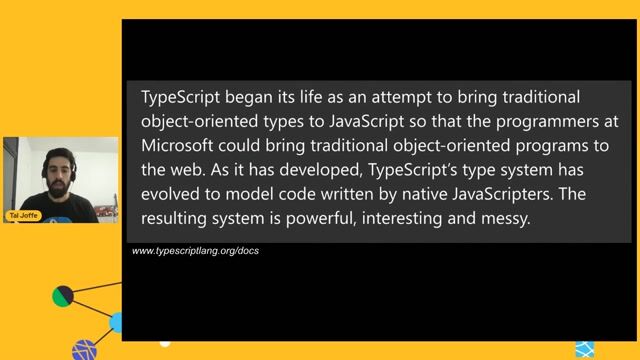
Understanding TypeScript's origins and role in scalability
All you need is types
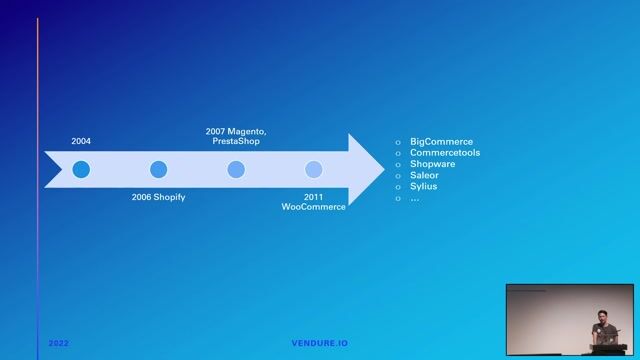
03:57 MIN
Why JavaScript and TypeScript dominate modern development
Modern Headless Commerce with Vendure
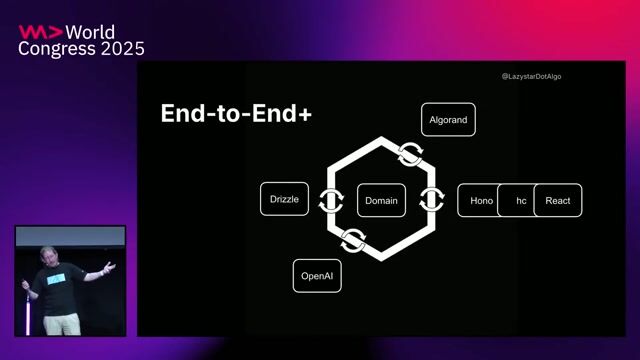
01:21 MIN
Final takeaways for building modern TypeScript applications
End-to-End TypeScript: Completing the Modern Development Stack
Featured Partners
Related Videos
 26:30
26:30Next, Nest, Nuxt… Nust?
Marius Obert
 32:28
32:284 Steps from JavaScript to TypeScript
Phil Nash
 37:18
37:18Building software that scales with Typescript
Tal Joffe
 28:13
28:13Building a large, complex product from the ground up with typescript & Atomic Design:lessons learned
Nathalia Rus
 26:32
26:32Nuxt.js - Just Vue 3 and a bit of magic?
Alexander Lichter
 41:22
41:22Building Better with Nuxt 3
Daniel Roe
 28:44
28:44Advanced Typing in TypeScript
Lars Hupel
 51:04
51:04Meet Your New BFF: Backend to Frontend without the Duct Tape
Noam Honig
Related Articles
View all articles



From learning to earning
Jobs that call for the skills explored in this talk.


Vesterling Consulting GmbH
Paderborn, Germany
Remote
NoSQL
Scrum
NestJS
Node.js
+6
Web & Söhne TMG GmbH
Vienna, Austria
€46K
Junior
API
CSS
GIT
RxJS
+5
Nestlé
Barcelona, Spain
Remote
Intermediate
JavaScript
Agile Methodologies
Software Architecture
Continuous Integration
Vesterling Consulting GmbH
Nürnberg, Germany
Remote
€50-75K
API
CSS
GIT
+7
Vesterling Consulting GmbH
Nürnberg, Germany
Remote
€50-75K
API
CSS
GIT
+6
Platri IT GmbH
Bochum, Germany
API
REST
NestJS
Node.js
Angular
+4
Sept Lieues
Paris, France
€65-70K
Go
C++
Java
Vue.js
+9