Your app is paused on the server and resumes on the client where it left off. See how this eliminates hydration for truly instant web applications.
#1about 2 minutes
The web performance problem with modern frameworks
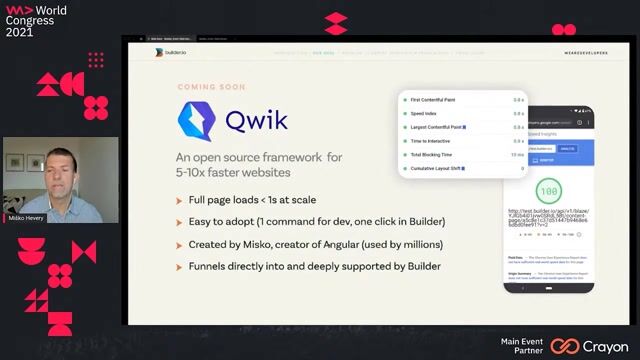
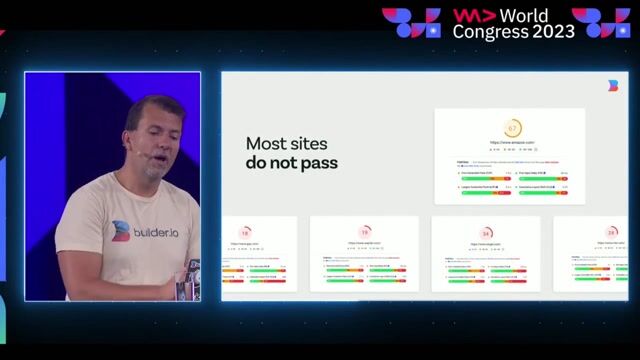
Most e-commerce websites struggle with poor Google PageSpeed scores because current frameworks prioritize runtime performance over time-to-interactive.
#2about 4 minutes
How replayable frameworks cause slow startup times
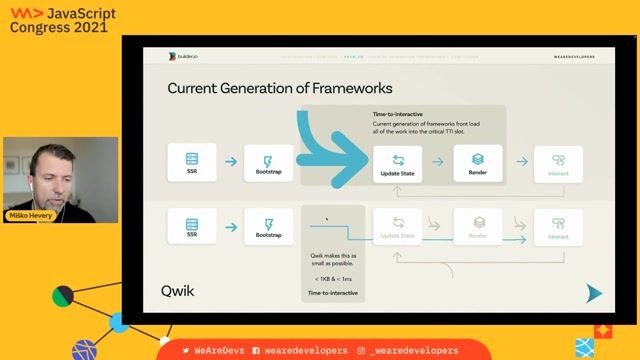
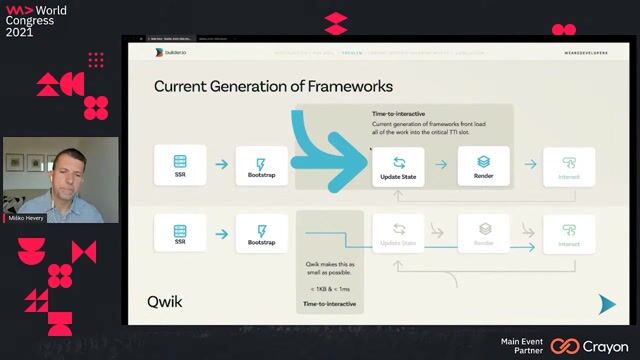
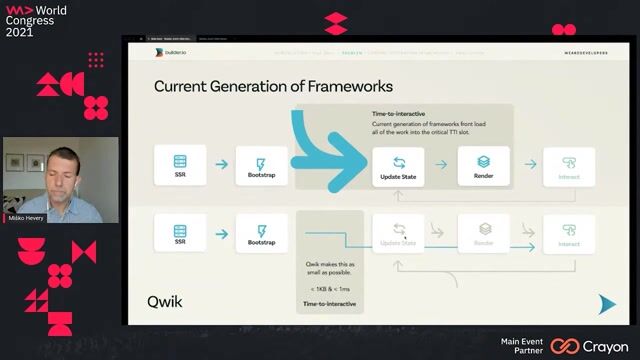
Traditional frameworks must download and execute the entire application's JavaScript on the client to "replay" the server's work and attach event listeners.
#3about 2 minutes
Qwik's resumable approach for instant interactivity
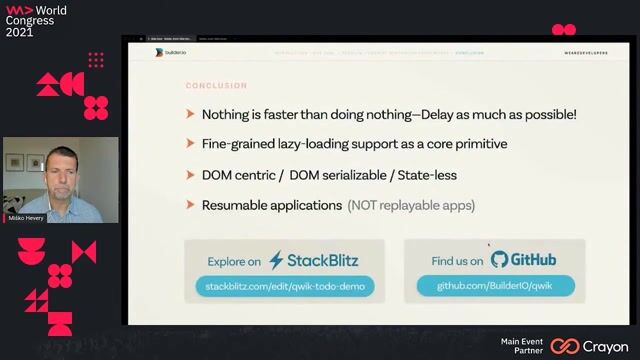
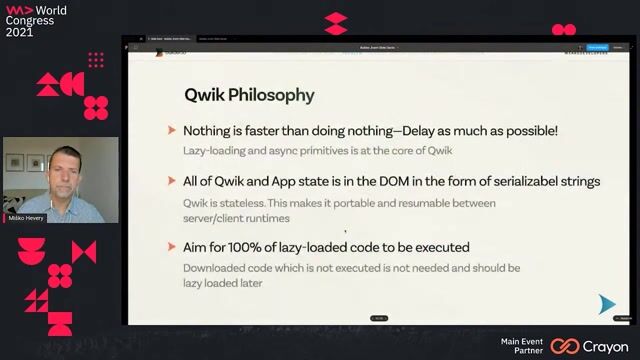
Qwik achieves near-instant interactivity by serializing application state and listeners into the HTML, allowing the client to "resume" execution with a tiny 1KB loader.
#4about 7 minutes
Comparing hydration models: monolithic, islands, and Qwik
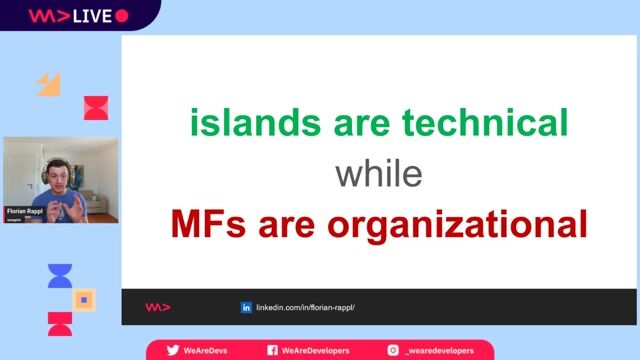
A visual comparison shows how Qwik's fine-grained, out-of-order component hydration is more efficient than monolithic hydration or the island architecture popularized by Astro.
#5about 4 minutes
Live demo of a Qwik to-do application
A to-do app demonstrates how Qwik downloads only a tiny loader initially, then fetches small JavaScript chunks on demand as the user interacts with the UI.
#6about 4 minutes
How the Qwik optimizer automates code splitting
The Qwik optimizer automatically creates lazy-loading boundaries using `Q hook` markers, eliminating the need for developers to manually configure code splitting.
#7about 7 minutes
Serializing component relationships for fine-grained reactivity
Qwik serializes component state and relationships directly into the HTML, enabling the client to perform targeted updates without downloading or executing the entire application.
#8about 4 minutes
Q&A on web components, SEO, and state management
The discussion covers the theoretical integration with web components and Shadow DOM, the positive SEO impact of serving pure HTML, and compatibility with state libraries like Redux.
#9about 8 minutes
Q&A on performance, architecture, and PWA capabilities
Questions are answered regarding HTTP request overhead, using Qwik as a full framework replacement, managing HTML size, and leveraging resumability for PWA offline state.
#10about 3 minutes
Q&A on integration, debugging, and dependencies
The final questions address the process of integrating Qwik into existing projects, debugging via DOM attributes, and the framework's ability to handle circular dependencies.
Related jobs
Jobs that call for the skills explored in this talk.
The Web We Broke (And Why AI Agents Are Paying the Price) - AgentCon BerlinThis is the accompanying post to the talk Chris Heilmann gave at AgentCon in Berlin on 19/05/2026, you can also see the slides and listen to it in this screencast:
Thirty years of developer shortcuts, bloated JavaScript, and inaccessible HTML have l...
Micro Components - a different approach to a simpler component-based webThere has been a lot of heated discussion lately in the web community about component based development. One side argued that Web Components are a standard we should follow whereas others complained that they still lag behind in what frameworks offer...
Daniel Cranney, Chris Heilmann
Dev Digest 215: Agent Memory, JS2026, Googlebot Analysis & Canvas❤️HTMLInside last week’s Dev Digest 215 .
🗿 Make AI talk like a caveman
🧠 A guide to context engineering for LLMs
🤖 Simon Willison on agentic engineering
🔐 Axios supply chain attack post mortem
🛡️ Designing AI agents to resist prompt injection
🎨 HTML in c...
From learning to earning
Jobs that call for the skills explored in this talk.