In Bitcoin, honesty isn't just a virtue—it's the most profitable strategy. See how economic incentives create a robust, honest network without central control.
#1about 4 minutes
Understanding Bitcoin's core economic incentive system
The network's design encourages cooperative and honest competition among nodes to create a reliable and scalable public ledger.
#2about 1 minute
The white paper's six steps for network participation
Following the six steps outlined in the white paper is the optimal strategy for any node to be a successful network participant.
#3about 3 minutes
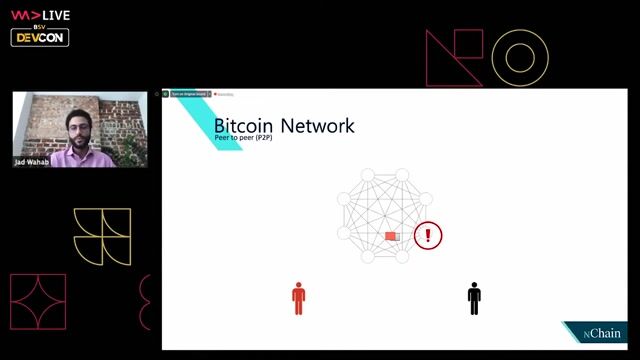
Broadcasting transactions creates a dense small world network
Nodes broadcast all transactions immediately to form a highly connected core network, which is crucial for efficient block propagation.
#4about 4 minutes
Building block templates using additive Merkle trees
Nodes efficiently collect transactions into a block template by additively building a Merkle tree and creating a Coinbase transaction for their reward.
#5about 4 minutes
Defining proof of work beyond just hashing power
Proof of work involves not only solving the hash puzzle but also the ability to handle massive transaction volume and build large Merkle trees.
#6about 7 minutes
Why nodes immediately broadcast blocks to avoid orphan races
A node must announce its solved block as quickly as possible to prevent competitors from finding a simultaneous solution, which would create a costly orphan race.
#7about 5 minutes
The process of block validation and pre-transmission
To speed up validation, nodes will pre-transmit the order of transactions in their block template before a solution is even found.
#8about 1 minute
How building on a block signals network acceptance
Nodes signal their acceptance of a new block by immediately starting to build the next block on top of it, reinforcing the longest chain.
#9about 6 minutes
Long-term network viability depends on transaction volume
The network's survival depends on achieving massive scale, where transaction fees eventually eclipse the block subsidy as the primary reward for miners.
#10about 4 minutes
How economic incentives naturally enforce node honesty
Dishonest behavior like creating an invalid block is economically irrational because other nodes will simply ignore it, wasting the dishonest node's resources.
Related jobs
Jobs that call for the skills explored in this talk.
Build With Bitcoin SVAt Bitcoin Association, we work to advance business using the Bitcoin SV (BSV) blockchain. A rebirth of the original Bitcoin, Bitcoin SV has restored the protocol to the specifications of creator Satoshi Nakamoto, resulting in a public blockchain cap...
Algorand Foundation
Why Blockchain? A Developer’s PerspectiveFor many developers, blockchain feels like that one friend who keeps trying to sell you on their side hustle: persistent, occasionally confusing, and often surrounded by hype. But behind the buzzwords and market noise lies a technology with real engi...
Algorand Foundation
From Hype to Code: Real Blockchain Use Cases for DevelopersSo you’ve wrapped your head around why blockchain exists . You’re on board with the concepts: decentralization, immutability, and trust-minimized infrastructure. But now comes the real question:
What can you actually build with it?
This post is for d...
Christina Schaireiter
Why and How to Sponsor Developer EventsA practical guide to decide if, where, and how much to invest in developer event sponsorships.
Sponsoring developer events is one of the few channels where companies can reach large-scale developer audiences and the technology leaders who influence a...
From learning to earning
Jobs that call for the skills explored in this talk.
















![Blockchain Keynote/Guest Speaker | Technology And Innovation [ESC1X203]](https://wearedevelopers.imgix.net/public/default-job-listing-cover.png?w=400&ar=3.55&fit=crop&crop=entropy&auto=compress,format)
