Build UIs that learn - Discover the powerful combination of UI and AI
What if your UI could predict a user's next click? Learn to build self-training apps that prefetch code and eliminate loading delays entirely.
#1about 1 minute
The performance problem of large single-page applications
Large component codebases in single-page applications can lead to significant loading delays and a poor user experience.
#2about 3 minutes
Using lazy loading and prefetching to improve performance
React's lazy loading API defers component loading, and dynamic imports can prefetch resources before they are explicitly requested by the user.
#3about 3 minutes
Predicting user actions with machine learning sequences
User navigation can be modeled as a sequence prediction problem, where a machine learning model predicts the next click based on past behavior.
#4about 2 minutes
Designing a neural network for click prediction
An LSTM (Long Short-Term Memory) neural network is well-suited for sequence prediction, using one-hot encoding to represent user actions without false correlations.
#5about 1 minute
Implementing the prediction model with TensorFlow.js
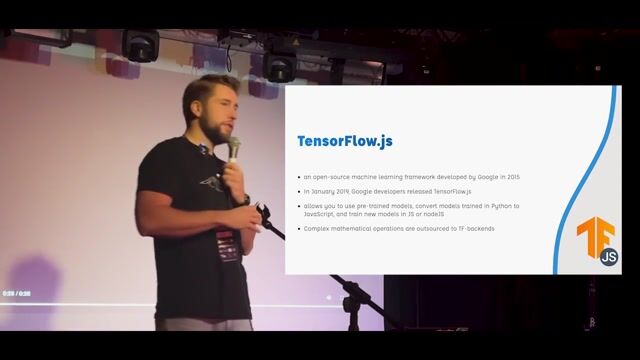
TensorFlow.js allows for building and running machine learning models directly in the browser using a sequential API to stack network layers.
#6about 1 minute
Training the model asynchronously with user data
The model is trained asynchronously in the background using the `fit` command, allowing the application to adapt to user behavior over time without blocking the UI.
#7about 3 minutes
Architecting a solution with the React Context API
A centralized architecture using two React contexts, one for prediction logic and one for prefetching, decouples the prediction source from the prefetching action.
#8about 3 minutes
Implementing the context-based prefetching logic in code
A custom `PredictionLink` component uses the `useContext` hook to listen for predictions and trigger prefetching via the prefetch context.
#9about 3 minutes
Summary of the intelligent prefetching technique
Combining React's code splitting with a browser-based machine learning predictor creates a powerful system for improving application performance by prefetching resources.
Related jobs
Jobs that call for the skills explored in this talk.
The Fastest JavaScript Charts - Built for React and BeyondFor most developers, browser charting works fine — until it doesn’t. Once you push beyond tens of thousands of points, add live streaming, or need advanced interactions, the story changes: frame drops, frozen dashboards, memory issues.
That’s where S...
Daniel Cranney, Chris Heilmann
Dev Digest 215: Agent Memory, JS2026, Googlebot Analysis & Canvas❤️HTMLInside last week’s Dev Digest 215 .
🗿 Make AI talk like a caveman
🧠 A guide to context engineering for LLMs
🤖 Simon Willison on agentic engineering
🔐 Axios supply chain attack post mortem
🛡️ Designing AI agents to resist prompt injection
🎨 HTML in c...
Dev Digest 198: 30 years of JS, In-Browser AI, How Attackers Abuse GenAI Inside last week’s Dev Digest 198 .
🎂 30 years of JavaScript
⏰ How long is a JavaScript second
💻 Clean code in Angular
🤦♂️ AI makes different mistakes than humans
👨💻 In-browser and offline AI
🟠 Undocumented Hacker News features
🐋 DeepSeek censored...
From learning to earning
Jobs that call for the skills explored in this talk.