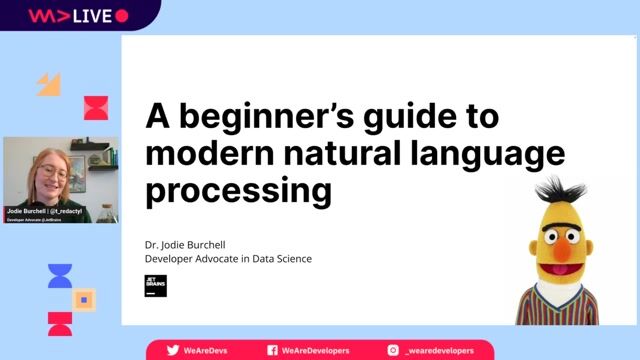
How can you find text about bravery with a negative sentiment? Learn to build a semantic search engine using Elasticsearch and the world of Harry Potter.
#1about 3 minutes
The evolution of NLP from early models to modern LLMs
Tracing the rapid advancement of natural language processing from early models like Word2Vec to the powerful generative AI we see today.
#2about 5 minutes
How vector embeddings represent language as numbers
Vector embeddings turn words and sentences into numerical arrays, allowing computers to understand semantic relationships through mathematical operations.
#3about 7 minutes
Using vector similarity and LLMs for semantic operations
The distance between vectors in an embedding space represents semantic similarity, enabling operations like finding related concepts or answering questions.
#4about 4 minutes
Using Elasticsearch as a vector database for search
Elasticsearch serves as a vector database to store document embeddings and integrates with models from sources like Hugging Face for inference.
#5about 7 minutes
Demonstrating advanced keyword search with the Python client
The Elasticsearch Python client enables complex, multi-field queries with boolean logic to filter data based on precise criteria before adding semantic layers.
#6about 4 minutes
Enriching data with sentiment analysis pipelines
An inference pipeline can automatically apply a sentiment analysis model to all documents, adding a new field to enable filtering by positive or negative tone.
#7about 4 minutes
Implementing semantic search with embedding models
By converting all text into vectors using an embedding model, you can perform a k-NN search to find the most semantically relevant results for a query.
#8about 5 minutes
Refining results with hybrid search techniques
Hybrid search combines the power of semantic vector search with traditional keyword filters and exclusions to create highly relevant and precise results.
#9about 19 minutes
Audience Q&A on models and implementation
The speaker answers audience questions about ensuring relevance, handling out-of-vocabulary terms, updating data sources, and debugging model outputs.
Related jobs
Jobs that call for the skills explored in this talk.
The Web We Broke (And Why AI Agents Are Paying the Price) - AgentCon BerlinThis is the accompanying post to the talk Chris Heilmann gave at AgentCon in Berlin on 19/05/2026, you can also see the slides and listen to it in this screencast:
Thirty years of developer shortcuts, bloated JavaScript, and inaccessible HTML have l...
SEO in an AI world - Google vs. ChatGPT and survival tips for content creatorsIn the ever-evolving world of technology, the landscape of search engines and AI tools is shifting at an unprecedented pace. This transformational journey is being shaped by the rising influence of AI-powered tools like ChatGPT, which are increasingl...
Chris Heilmann
With AIs wide open - WeAreDevelopers at All Things Open 2025Last week our VP of Developer Relations, Chris Heilmann, flew to Raleigh, North Carolina to present at All Things Open . An excellent event he had spoken at a few times in the past and this being the “Lucky 13” edition, he didn’t hesitate to come and...
From learning to earning
Jobs that call for the skills explored in this talk.